September – October 2024
Editing Part 2
Last month we looked at the WHEN and BIG PICTURE of editing. This month, I’m looking at some of the best ways to read your writing, what you should be looking for and where to go for help.
HOW
It’s all too easy when reading our own writing to read what we think we wrote. So here are some suggestions to get over that:
- ALWAYS read your work out loud. It’s so much easier to hear mistakes such as unintentional repetition of certain words and phrases, badly constructed sentences, too many adverbs, no change of pace. By reading it out loud, you will also notice typos and misspellings.
2. If you’d like someone else to read your writing out loud, you’ll need a very understanding writer friend! Or you can use the Read Aloud facility on your computer (you may need to have a word processing package subscription to use this).
I’ve set up a new page Computer Tips where you’ll find how to do this with MS Word. Computer voices have improved a lot over the years, and I’ve just had a very nice woman read this all back to me!
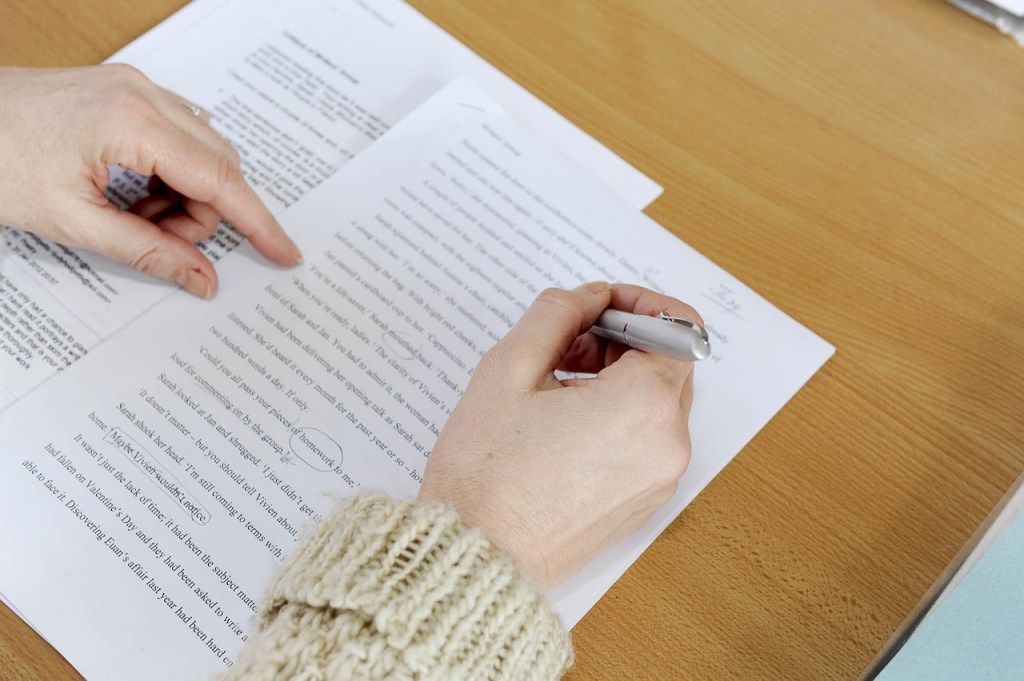
3. If you can, print out your work before reading it out loud and editing it. A change of medium often helps as it will come over as a “new” piece of writing. I use a red pen to mark any mistakes which are then easily identifiable when correcting back on the screen.
4. If you are editing on the screen, then highlight the whole piece of writing and change the font.
Don’t be tempted to try one of the more outlandish fonts that Microsoft Words offers, like Algerian or Broadway. They are fun to experiment with if, say, you are designing a poster. But for any length of writing, they are difficult to read.
I usually change from Times New Roman to Ariel and then back again when I’ve finished editing and I’m going to send it off. Times New Roman is an industry standard, so it actually makes sense to set your word processing package to using that font all the time (the default font).
Have a look on YouTube – I’ve found a couple of videos that explain it. And you’ll find my guide on How to change your default font on the new Computer Tips page.
5. Alternatively, changing the colour of the font can have a similar effect, making you read your writing more carefully.
WHAT TO LOOK FOR
Mostly, you’ll be looking for consistency, such as the spelling of names, place and proper nouns.
Dialogue tagging – have you stuck to he said, she said, rather than use a lot of fancy alternative.
Grammar – reading out loud should help you pick up errors.
Punctuation.
Unintentional repetition of words or phrases.
Exceptionally long sentences.
WHO CAN HELP
You can, of course, do all this editing yourself. But it’s all too easy to read what you think you’ve written. If you have writing buddies who are willing, then my suggestion would be to ask them to do specific editing eg are they engaged by the characters? Another friend might like to read your writing as a reader – does it grab them and make them want to read to the end? Another friend might be good at spotting typos, grammar and punctuation mistakes.
Another option is to use editing packages – free and paid-for..
You will have to look at each one to see what it offers. Some are free but then offer more features if you pay.
Grammarly
Prowritingaid
Hemingway editor
Autocrit
The one I have used several times is Authors AI. You can have your whole novel analysed for free, and for $45, you get a more detailed report – mine was 30+ pages long! Their web address is authors.ai
You can always pay for a full editing check of your writing – costs vary enormously. You can be charged by the word, the page, by the hour or a flat fee.
The Chartered Institute of Editing and Proofreading charge £25+ per hour for proofreading and £34 per hour for developmental editing.
The Literary Consultancy charge £1000+ for up to 60,000 words.
The Oxford Editors charge £820 for 100,000 words.
Some professional companies also offer Zoom meetings, express delivery, mentorship etc – all at extra costs.
Have confidence
As with all outside editors (whether free, friends or professionals), it is totally up to you what you do with the feedback. My advice? Read what they say but have confidence in your own writing.
Once you are happy with your editing, you might want your mother/auntie/boyfriend to have another read. I can guarantee they won’t spot the edited adjectives and adverbs, the change from passive to active verbs, the shortened (or lengthened) sentences. But they might just say “That reads really well now! I didn’t notice any difference.”
Only YOU will know the work that has gone into making your writing that much better.
Happy writing!
Linda