Workshop 3 – Fast and Slow: the art of Pacing
Last month we talked and wrote about Ups and Downs in a plot. This month, I want to look at Fast & Slow – the pace of your story. Like Ups and Downs, your stories could become flat and uninteresting if they are written at the same pace. So, it follows that you need some fast action and some slow.
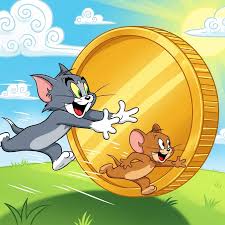
Fast writing could include: an argument; a fight; a chase (Easy-Peasy-AI for Tom and Jerry pic); jumble; an attack; rushing to catch a bus; rushing to get somewhere on time
Slow writing can be: staring at a beautiful landscape/sunset; recovery after a chase; washing up on one’s own after an argument; descriptions.
There are many writing devices that can be used to quicken your story, or to slow it down.
Fast: short sentences and short paragraphs; quick, short dialogue; sentence fragments; hard consonants; clipped speech; fewer adjectives and adverbs; fewer thoughts.; sudden changes; revelations.
A faster pace is useful to
- break up too much description
- introduce sudden changes, turning points and climaxes
- keep the plot going
Slow: longer sentences with multiple clauses; more detailed descriptions; softer words; feelings; using the senses more; internal thoughts; flashbacks; subplots; reflective dialogue.
A slower pace helps to
- build the atmosphere and mood of a scene
- develop characters and backstory
- allow the reader a rest after fast, busy scenes.
The same scene in a story can be written as fast pace or slow pace, depending on the story’s structural needs at the time.

Maggie turned the corner and there it was – her old school. She took a deep breath and forced herself to think positively. Was she doing the right thing? People said that you shouldn’t go back, didn’t they? But this was familiar ground, and after so much change, so much upset, this was what she needed. The playground had hardly changed over the years. Oh, maybe it had, a little. There was a new climbing frame, a smart, modern one. In her time there had only been an old slide with broken steps and side panels missing. That wouldn’t be allowed today – health ands safety! She took a step forward and opened the gate – yes, that was the same, still squeaking.
Maggie rushed round the corner. God! It hadn’t changed at all! Gate still squeaked. She marched across the playground and flung open the door. “Headmaster’s office?” she demanded of a passing child.
Exercises:
- Write an argument between two people, using sentence fragments and clipped speech
- Write a chase scene from (a) the POV of the chaser and (b) the POV of the chased
- Write the aftermath of one of the above (1 or 2) – slowing the pace right down
- Your POV character is washing up, daydreaming as she/he stares out of the window. They are thinking through a minor problem/situation. Then they see something out of the window which makes them react eg an old lady falls over in the street; a kid takes another kid’s bike; someone jumps over next door’s fence
Writing practice:
Develop one of the exercises into a short story, remembering to vary the pace.
ps The schoolyard photo above is by Mario Amaral on Unsplash
—————————————————————————————————————————–
Workshop 2 – Ups and Downs; Highs and Lows
Take a look through your day. When was it “up”? An unexpected meeting with a friend? Finding just the right dress for a special occasion? Finishing a piece of writing?
And the “downs”? An expected telephone call that never comes? A larger than expected bill? An argument?
“Downs” aren’t necessarily negatives. They could just be a quiet or resting state, such as daydreaming on a train journey, a glass of wine watching the sun go down, sitting quietly with a friend.
We all probably know people who seem to be on the go the whole time, rushing from one activity to another, hardly pausing for breath. They may seem to get a lot done but I’m sure they also need a good amount of “down” time at some point.
Like life, if you don’t have ups and downs in your stories, they may appear flat, uninteresting and, unfortunately, a bit boring.
Plot points

“Ups” are often action points, when something happens to change the course of the story. In novel writing, these may be called plot points and there are plenty of blogs and articles on the Internet explaining plot points. James Scott Bell is one of my favourite authors and writing tutors, and this link will take you to his excellent article on what plot points should be. You can also buy his book Plot and Structure on Amazon. Click here.
In flash fiction, one up and one down is all that you’ve time for. In short stories, maybe 2,3 or 4. In a novel, many more.
Authors AI
I’ve mentioned this company before. They provide computer-analysed reports on your novel, covering a whole host of features, such as dialogue, narrative, use of language, and readability. And that’s just in the free version! What they also include is a comparison of your novel’s arc with that of a well-known novel.
In my case, they compared my historical novel’s structure with The Last Precinct by Patricia Cornwell. I have to say I was well pleased with the comparison as I love Cornwell’s Scarpetta novels.
Here it is: the mauve line is The Last Precinct and the green is my historical novel.
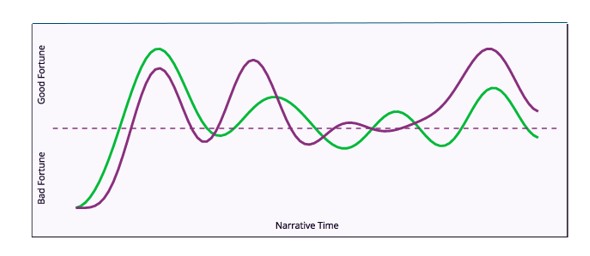
Their comments were:
- While the genres are different, it does suggest that the emotional experience of your readers will be similar. Knowing about other books with similar plotlines will help you understand the experience your readers will have;
- The tops of the arcs are where the story takes a hopeful or positive turn, signified by joy, excitement, love, relief.
- The downward dips show the story taking a darker turn.
If you would like a free analysis of your novel by Authors AI, click here.
Exercises:
- Look back at your day yesterday and note yours Ups and Downs. Ask your partner or a friend what Ups and Downs they had.
- Look at your day ahead and anticipate the Ups. At the end of the day, check back.
- Think back to a favourite book or film and note down the points at which the story changed, for the better or the worse.
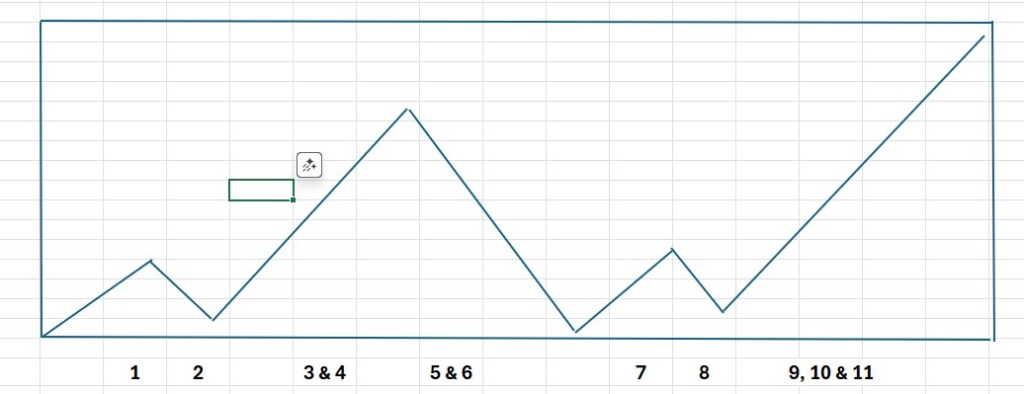
- Analyse a fairy story for Ups and Downs. This is my suggestion for Cinderella.
1 U Invitation to the ball
2 D Ugly sisters saying she can’t go
3 U Meeting her fairy godmother
4 U Meeting the Prince
5 D Having to leave at midnight
6 D Back to drudgery
7 U The slipper hunt
8 D Sisters keeping her away
9 U Buttons to the rescue
10 U The slipper fits
11 U Happy ever after
And the visual:
Writing practice:
- Write a scene with one character who experiences a series of ups and downs during the course of just a morning.
- Plot a story using up and down points.
- Have a look at one of your stories and see if you can draw the story arc of ups and downs. Does it compare well to the example from Authors AI?
Feedback
As always, if you have any comments, please do get in touch.
Workshop 1 – How observant are we, as writers?
As writers, our aim is to create images for our readers. So it follows that we should be writing realistic, believable descriptions of people, places and things. (If you are creating a completely new world, then you have to work twice as hard imagining all these things!)
To do that, it is important to develop our observing skills.
When you go out and about, what do you notice? Are you someone who loves cars and you know what all your neighbours, friends and colleagues drive? Or are you a fashionista and you remember what everyone’s wearing in your coffee group? Or perhaps it’s hairstyles that you notice, or handbags, or … nothing in particular!
Behaviour, emotions and reactions
Perhaps you are more of a “people person”: not necessarily noticing what they are wearing but rather how they behave, what emotions they show, how they react to others.
All those are certainly aspects of our world that we need in our stories. But are you missing out on some that would undoubtedly improve your writing?
I know I’m not very good at noticing what people are wearing. I’m just not that interested! (And it follows that I am definitely not a follower of fashion!) So, from time to time, I make a concerted effort to notice what others are wearing. I never admit what I’m doing when a group of friends gets together. But I do try to take notice and jot down a few notes later on.
Readers love detail
Descriptions of anything, whether it is someone’s behaviour or a place or an object, will always add depth to your writing. Readers love detail. The ones that don’t will skip the description paragraphs.
Some writers love writing detailed descriptions of their characters, others don’t. One thing I would recommend: you, as the writer, probably have a very clear picture in your mind of what your characters look like. You might even use a storyboard with pictures cut from magazines. If you want your readers to have the same image in their minds, then some description, whether it’s clothes, hairstyle, or quirks, will definitely help.
Get into character
So far, I’ve written about what WE should be noticing. But when it comes to our writing, we must remember to get into character. What I particularly notice when walking on the beach is not, necessarily, what a teenage boy or a just-retired man might notice.
Writers need to get into their character’s mindset and also, almost literally, into their shoes. One of my favourite quotes is from the lawyer Atticus Finch in To Kill A Mockingbird:
“You never really understand a person until you consider things from his point of view… until you climb inside of his skin and walk around in it.”
Exercises:
- Go somewhere with a companion, perhaps a writing buddy, friend or family member. Don’t tell them there is a point to this excursion. On return, discuss what you each noticed eg in a supermarket, cafe, restaurant, on a walk, in a shop, on the beach.
- Choose a character for your POV character eg a child, an elderly person, a foreigner, a man who’s just lost his job, a woman who’s been jilted. Select a particular place and then, through their eyes, note what would each of them have noticed?
- Remember to use all your senses in your observations eg what you see – the most used; the senses of smell and hearing – these really add to the atmosphere of a place. Also, sense of touch and taste.
- Make a point of noticing colours while you are on one of your trips. I often wonder whether we live in a black and white world as I’m reading because colour is rarely mentioned. A splash of colour will resonate with your readers and bring the scene more to life. Just don’t overdo it!
- What you notice will change with the weather and the light. So will how people behave. In Kate Mosse’s talk (see June blog), she pointed out that the sunlight from one of the church windows was falling directly on the opened Bible on a lectern. She noted the time and said it was something that could well be used in her writing.
- What speech do you notice when you are out? It may be a snatch of an overheard conversation, sometimes just a word or two. It may be a bit of an argument. Or an exchange between lovers. They are all worth noting. In an Irish hotel restaurant one morning recently, a waitress came up to me and said, “I’ve just come on shift and I’m getting a feel for the room.”
- As well as what people are wearing, note too different people’s demeanour. Are they on a mission and walking fast, with a purpose? Or are they totally relaxed, without a care in the world? Do they smile when they meet people? Or do they walk with their head down? Do they wave expansively at others or keep to themselves?
- I would suggest keeping a notebook just for the purposes of observation. A pocket-sized one would be ideal, unless, of course, you prefer to record your words on your phone.
Writing suggestions:
- Write a character profile of up to 300 words, using someone you particularly noticed on a recent excursion. This will be a composite person, taking what you’ve noticed from different people. What were they wearing? How was their demeanour? How did they speak? What would THEY have noticed?
- Turn your character profile into a scene or a short story. Decide on what your character wants on a particular day. How are they going to get it? What stands in their way?
Feedback:
If you’d like to send me comments about this workshop, please do. I’d love to hear if you use some of the exercises, either on your own, with a friend or in a writers’ group.
 Let's Get Writing