
Subscribe to continue reading
Subscribe to get access to the rest of this post and other subscriber-only content.
Subscribe to get access to the rest of this post and other subscriber-only content.
Websites & Webinars for Writers
I’m sure you’ve already discovered there are hundreds and thousands of websites for creative writers, and a whole variety of webinars and podcasts: you could probably find a different one every day for the next twenty years! But you can also waste a lot of time trawling through such sites to find one that suits you.
One thing I’ve found is that if you sign up for a particular website, you can be inundated with e-mails, not just one a month or even one a week, but almost every day. And like writing magazines (in my experience), they often get left until you find the time to sit down and concentrate on what you’re reading.
Creative Writing websites vary enormously
So, I’m going to offer just a few websites and webinars that I have found interesting and/or useful over the years. Do have a look, and if you have your own favourites, perhaps you’d like to share them with Let’s Get Writing readers – via the Feedback form.
Websites
3. Reedsy – this is a marketplace so lots of selling, but also articles, plus The 50+ best writing websites of 2025
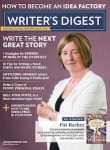
4. Writer’s Digest – American print magazine which I have subscribed to before now. In-depth articles, plus 100-word story competition – good for getting going and group activities
Webinars
Again, hundreds available but do look carefully to see if there’s a cost. Sometimes, organisations will charge £40 for a webinar of between one and two hours. If you know and like the presenter, absolutely fine. If not, try the free ones first.
Webinars can be live or recorded. I tend to mostly watch the live ones as you can often ask questions, make comments and interact with other writers.
These are the two I’m most familiar with:
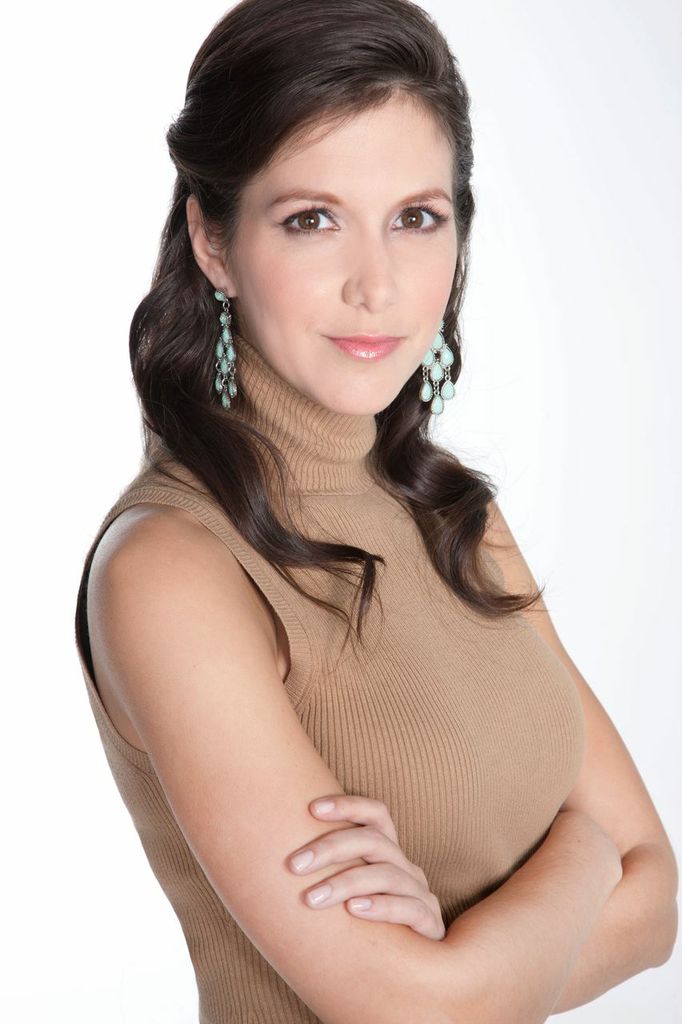
Authors AI. Their main business is using AI to analyse your novel. There’s a free version, plus paid ones. I’ve used both and find them most useful. They also put on regular webinars, usually presented by AI co-founder Alessandro Torre (see left), interviewing an American (usually) novelist. They last half an hour and can be entertaining and interesting. Recommended.
I also recently joined a webinar run by Jericho Writers, called Big Picture Editing, which was well-presented, well-structured and offered a different look at editing. Recommended.
Other companies that run free webinars include: Lulu Publishing; Curtis Brown Literary Agency; Reedsy; BluePencil Agency and WriteAcademy.
If you have experienced other webinars that you’d like to pass on, please do so through the Feedback button.
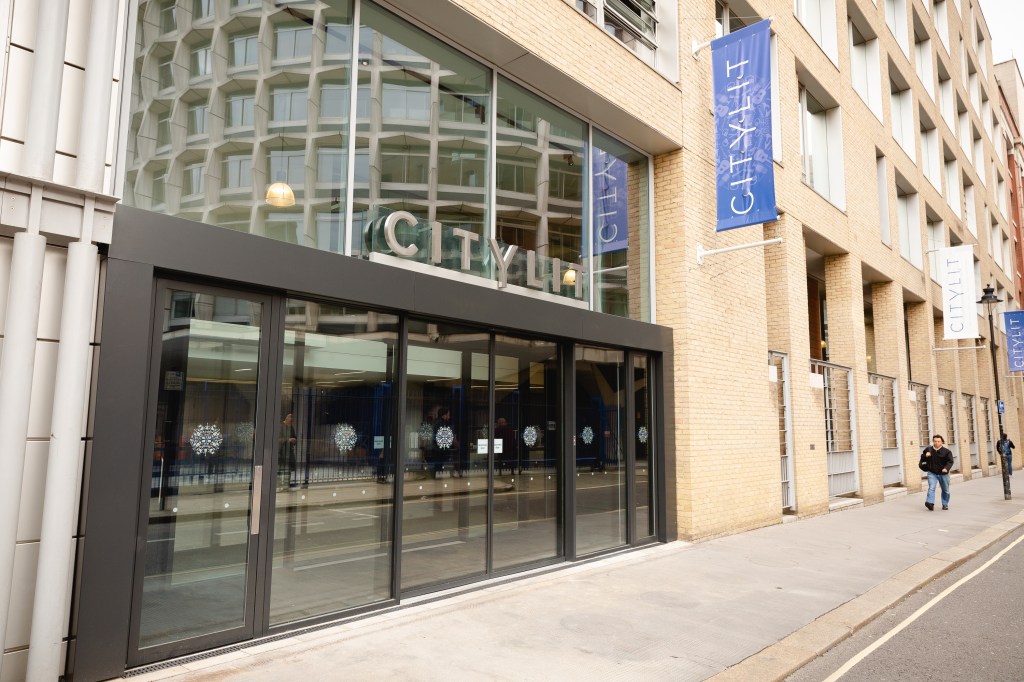
Last month I asked if anyone had experience of writing courses. Writing friend Brian contacted me about the courses he’s been on at the City Lit in London. It’s near Lincolns Inn Fields and the address is 1-10 Keeley St, London WC2B 4BA.
Here’s Brian’s experience:
My first course there, after retirement, was an introduction to journalism. I enjoyed two terms, met interesting people but failed to write any memorable articles. Perhaps, because as I later discovered I enjoyed writing stories that were only seemingly true. My next course was an Introduction to Short Story writing. This was a good mixture of prescription and practice. Over ten weeks, we wrote three long stories, receiving comprehensive feedback on the originals and two further edits. I was more in my creative comfort zone now. On two further creative writing courses, I wrote enough stories to fill an anthology and, much late, when I discovered Lulu, a self-publishing website, I published First Coarse, a pun on the standard of my writing and its source.
The next stage in my writing journey was to investigate travel writing at the nearby Mary Ward Centre. Here, I discovered I had forty years of history, featuring journeys taken in my many cars, to fill a book. I used Lulu to self-publish to publish Road Works – the drives of a lifetime.
In more recent times, I’ve attended one day courses on writing for children, one on straight storytelling and one on picture books. Both courses provided a good foundation of the elements required for each genre.
Thank you, Brian.
Happy writing in March and April. I’ll be back in May.
Linda
I mentioned back in November that I would write about some of the courses I have done over the years – the good and the not-so-good bits. The good ones I have named. The not-so-good ones I haven’t, because they might well have improved by now. And there hasn’t been a single course that I’ve attended where I haven’t learned something about writing.
Firstly, why should you, as a writer, go on a writing course?
2. Feedback is SO important for writers, and courses can be a really good way of finding out if your writing works for other people – both the experts running the courses and your fellow writers.
3. Going on courses will motivate you into improving and continuing your writing. There’s nothing like a few days or a week being totally immersed in writing to keep you going and realising what you are capable of.
4. Taking part in course exercises or working on your own projects will increase your portfolio. Nothing you write need ever be wasted. Make sure you keep all your writing – who knows? A suitable competition might crop up, while trends in subject matter change all the time.
5. And writing courses can be very sociable. You may well develop new friendships and even a writing buddy or two!
Courses can be in person or, nowadays, there are so many online opportunities.
The courses that I have found the most useful in recent years have been online with the Curtis Brown literary agency.
I did one six-week course in which there was a recorded video lesson every week from an established writer in my chosen genre, plus exercises, some of which you were encouraged to submit to fellow writers for feedback. At the end, you could also pay an extra fee for tutor feedback.
4-week courses cost from £135; 6-week courses £230; 3, 6 and 8-month courses range from £1500 upwards.
Here’s the link to the Curtis Brown page.
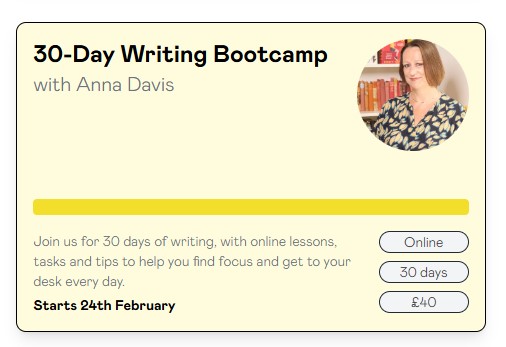
Curtis Brown also run online Bootcamps – these are for a month at a time, where you are given a prompt every day for a 700-word piece and asked to submit a piece every three days for feedback from fellow participants. I did two of these bootcamps and found them ideal to get me back into a regular routine. They are extremely reasonably priced at £40 each.
Hundreds of courses
If you search for writing courses on the Worldwide Web, you will find hundreds. They can be run by literary agents, colleges, groups, companies and individuals. I would suggest trying to find someone who’s been on the course that interests you – personal recommendation is the best. Or contact the course provider to ask the questions you have.
Not at all conducive
Having said that, a writing friend went on a most productive retreat down in Devon. Daytime was spent writing in your own room or, if preferred, in quiet company in the public areas. All meals were provided. In the evenings, there was plenty of writerly chat with other participants, with readings and critiquing.
I went to the same place more recently and was dismayed to find that I was the only writer of three people staying that week – the other two having won the retreat in a (non-writing) competition. I didn’t find my room particularly conducive to writing all day, and having to creep along a corridor to the bathroom at night was the last straw – I didn’t stay long!
Out of action
And there was the time I went on a residential week’s course in Wales. I’m not naming the venue as the week turned into a disaster! A rather virulent tummy bug hit nearly all the participants. I was out of action for two days and just managed to drive home afterwards instead of joining friends to climb Snowden! But the course itself did give me valuable feedback on the opening of a novel which I am now editing with a view to self-publishing later this year. I was also introduced to the Zig-Zag method of cause and effect for story writing which I now use for all my stories. And I still have, and refer to, my notes on the tutored sessions I was able to attend!

Finally I want to mention a place that I absolutely loved in the eighties and nineties: the Earnley Concourse in West Sussex. It was an adult residential learning centre offering a whole host of courses in a lovely setting, complete with garden peacocks! I attended eight courses there, on art, croquet and photography, as well as three excellent writing courses.
One of those was run by Frederick E Smith, author of the novel 633 Squadron which was made into a film starring Cliff Robertson and George Chakiris (on TV again this Christmas!). Such a shame the centre closed many years ago and the site is now being considered for housing.

I hope I’ve given you some encouragement to look at going on a writing course. Do let me know if you have your own experiences to share here.
Next time, I’ll write about Creative Writing webinars and websites.
Happy writing!
Linda
Free Writing – a device to get you going
When did you last sit down and do a few minutes of free writing? That’s just writing, without editing, without judging, without taking your pen off the page or your fingers from the keyboard.
It’s a really well-used, traditional writing device that can
get you going;
help get round any anxiety or mental block;
build up writing stamina and muscles and
create a daily routine.
Free writing was originally developed by Peter Elbow, a professor of English Emeritus at the University of Massachusetts Amherst in 1973. His idea was that you wrote for a few minutes, took an idea or word from that freewriting and used that idea to free write for another few minutes. This process could then be carried on for as long as you wanted.

Nowadays it tends to mean you can write about absolutely anything – a stream of consciousness, thoughts on waking, a rant at someone or something, a character profile, what you’re going to do today – anything that takes your fancy and gets you writing.
It’s not, usually, meant to be shared but if you’re with your writing buddy or in a group, then you can, of course, if you want to. Otherwise, free writing can be just left, or even erased, having done its job in getting you started. It might, though, result in an idea for future writing; a couple of paragraphs might be used in a short story or whatever your work-in-progress may be.
Brilliant motivator
I was reintroduced to this writing device a few weeks ago when I went on an excellent course in Portsmouth – Write Your Historical Novel – run by William Sutton. He’s a brilliant tutor and motivator so I was “happy” to put up with rather cold room we were in! He used free writing exercises in every session. He usually gave us a topic, or the choice of several, and we could do what we liked with the exercise. Some of the writers were just beginning their novel-writing journey, others were some way into their novels, and a couple, like myself, had finished the writing and were now starting the editing process.
Whatever the topic, I found I was able to relate it to my novel enabling me to
a) take a fresh look at particular scenes,
b) use a different point of view and
c) come up with interesting plot changes.
The idea of just writing, with no judgement, seemed to free me up from what I had planned. I’m definitely a planner, not a pantser, so this came as a bit of a surprise.
I’ve kept my free writing exercises all in one notebook and I have to say that I have found them extremely useful as I work through my novel, taking on board various critiques that my Beta-readers have suggested.
I’ll just add here that William had a whole host of excellent ideas and advice relating specifically to Historical Novel writing. He runs different workshops and classes so if you are in or near the Portsmouth area, do have a look at his website. Click here.
Christmas writing suggestion

I know we’re all getting really busy preparing for the festive season – lunches, dinners, shopping, friends, family, Christmas TV, cards and presents. But even amid all this activity, you might find you have the odd five minutes to keep up your writing.
It might be a lot to ask you to continue with your work-in-progress with all the distractions around! So you could use those little bits of time to free write. It might be for 2 minutes or 5, or, as we found in our sessions, you just want to carry on! It’ll be a break from the mince pies and sherry, and it will keep you writing.
And to help you get started, there are 20 Christmas prompts on the new Prompts page. Click here.
Do let me know if that’s helpful for you.
Have a lovely Christmas and wishing you all the best for 2025.
Happy writing!
Linda
What sort of writer are you? And is there a right or wrong way?
This month I thought I’d address the topic of how do we write – completely alone, with someone, or in a group? What’s best and what might work for you?
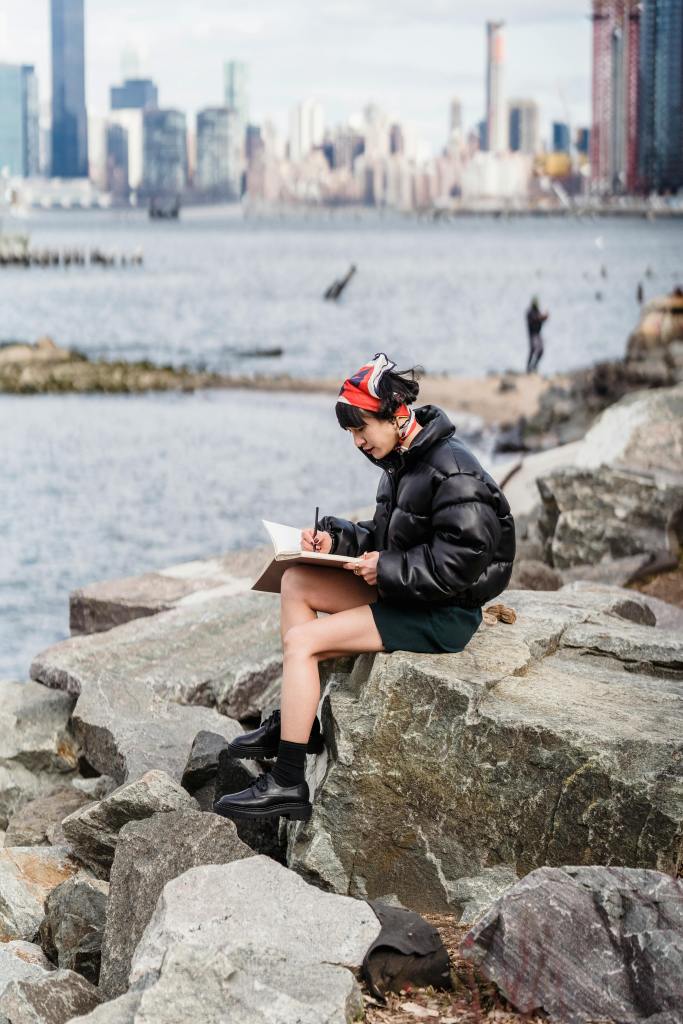
We all have our own way of writing, and it might change depending on what we’re writing, our mood and our situation. On holiday, I like nothing better than to go to a beach, preferably where there’s no-one else about. If it’s warm, I’ll sit on the beach; if not, in the car. Staring out at the waves invariably puts me in a good mood and I have spent many hours writing happily in such a state.
At home, I’m fortunate to have a small office that looks out onto my garden. And although this is where I do a lot of writing, unless I’m really in the “zone”, I find there are too many distractions. You’ll probably recognise some!
Is writing alone the way to go?
If you read the opinions of famous writers, it would seem so!
Ernest Hemingway said: ” Writing, at its best, is a lonely life. You must be prepared to work always without applause.”
Gustave Flaubert: “Writing is a lonely life, but the only life worth living.”
Franz Kafka: “Writing is utter solitude, the descent into the cold abyss of oneself.”
And on a brighter note! Margaret Atwood: Writing is alone, but I don’t think it’s lonely. Ask any writer if they feel lonely when they’re writing their book, and I think they’ll say no.
No distractions
What these writers are saying is that the actual physical work of writing is best done on one’s own with no distractions. But I firmly believe there is a place for writing with others, and meeting and/or socialising with other writers. There are so many options: it’s just a case of finding what works for you.

In the New Year I hope to blog a bit more about courses, telling you about the ones I’ve found useful and enjoyable. If anyone has similar stories they’d like to tell, please do send them via the Feedback button.
So, is it best to go Solo? My preference to is to write on my own, in silence, resisting telephone calls and emails. And then, to go to any or all of the above to be sociable, and to keep up my motivation and learning.
Happy writing.
Linda
Do you like reading paragraphs or even pages of description? Do you love every detail of every place, building, street, garden, house, furniture, person and their pets in a story?
Or do you sometimes find yourself skipping over some of those paragraphs, hoping to find the action or conversation that will take the story forward.
It is too easy to include a lot of information in fiction writing, believing it to be essential to the story. But when there is a description overload, then I feel the author hasn’t given enough thought as to what the story needs.
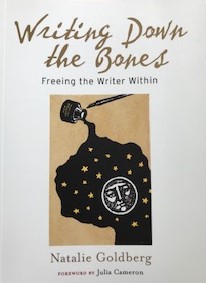
…there is a fine line between precision and self-indulgence
This is a quote from Natalie Goldberg’s book Writing Down the Bones – one of my favourite “How To” books on Creative Writing. It was written in 1986, sold more than a million copies and has been translated into 12 languages. (See link below)
I came across this particular quote when I was reading a few chapters (they are very short) the other day, hoping for inspiration. I got it! What immediately came to mind was those long passages of description that I have, unfortunately, been reading (or skipping) in quite a few books recently.
What is description? It could be setting the scene, describing someone’s clothes, or taking the reader through a five-course meal.
Please don’t get me wrong: I am very much in favour of using personal experience and/or research to bring authenticity to a story – you have to if you don’t want bland writing that doesn’t connect with your readers.
But how much is enough?
We’ve all probably done some research for a story, whether it’s the latest technology for a sci-fi tale, or what clothes they wore in the 15th century. Having done the research, we want to put it to good use. But that is the point at which you, the writer, must identify what the READER needs to know, rather than what YOU know.
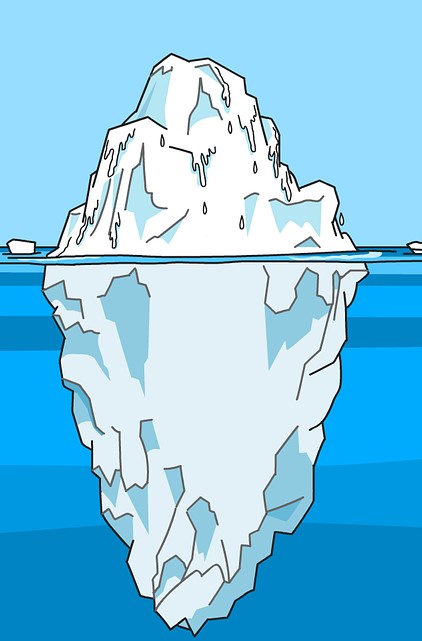
Ernest Hemingway had his “Iceberg” theory: “If a writer of prose knows enough of what he is writing about, he may omit things that he knows and the reader, if the writer is writing truly enough, will have a feeling of those things as strongly as though the writer had stated them. The dignity of movement of an iceberg is due to only one-eighth of it being above water.”
Over-writing is often described as PURPLE PROSE – writing that is showy, overly flowery; drawing attention to itself rather than progressing the story.
Sadly, new writers often tell me that “the words just poured out of me, so they have to be good, don’t they?”
I’m afraid not. That’s PURPLE PROSE at its worse – masquerading as words that flow when they and the plot have been well thought out and the author is thinking about every word.
How to avoid Purple Prose or
The dividing line between precision and self-indulgence:
Don’t mistake Purple Prose for Literary Writing. We could spend hours discussing what, exactly is Literary Fiction! Authors of literary fiction are experts at using the right adjective at the right time, the right amount of description and the right words, even long ones, at the right time. Their writing flows and is beautiful to read. In addition to using metaphors and similes in the right place, they often employ other literary devices such as hyperbole and personification.
Genre writing on the other hand tends to be more direct, with more conversation and often more action. I believe it is just as hard to write good genre fiction as it is to write literary fiction. The choice is yours!
Happy writing!
Linda
Click here if you’d like to buy Natalie Goldberg’s book.
September – October 2024
Last month we looked at the WHEN and BIG PICTURE of editing. This month, I’m looking at some of the best ways to read your writing, what you should be looking for and where to go for help.
HOW
It’s all too easy when reading our own writing to read what we think we wrote. So here are some suggestions to get over that:
2. If you’d like someone else to read your writing out loud, you’ll need a very understanding writer friend! Or you can use the Read Aloud facility on your computer (you may need to have a word processing package subscription to use this).
I’ve set up a new page Computer Tips where you’ll find how to do this with MS Word. Computer voices have improved a lot over the years, and I’ve just had a very nice woman read this all back to me!
3. If you can, print out your work before reading it out loud and editing it. A change of medium often helps as it will come over as a “new” piece of writing. I use a red pen to mark any mistakes which are then easily identifiable when correcting back on the screen.
4. If you are editing on the screen, then highlight the whole piece of writing and change the font.
Don’t be tempted to try one of the more outlandish fonts that Microsoft Words offers, like Algerian or Broadway. They are fun to experiment with if, say, you are designing a poster. But for any length of writing, they are difficult to read.
I usually change from Times New Roman to Ariel and then back again when I’ve finished editing and I’m going to send it off. Times New Roman is an industry standard, so it actually makes sense to set your word processing package to using that font all the time (the default font).
Have a look on YouTube – I’ve found a couple of videos that explain it. And you’ll find my guide on How to change your default font on the new Computer Tips page.
5. Alternatively, changing the colour of the font can have a similar effect, making you read your writing more carefully.
WHAT TO LOOK FOR
Mostly, you’ll be looking for consistency, such as the spelling of names, place and proper nouns.
Dialogue tagging – have you stuck to he said, she said, rather than use a lot of fancy alternative.
Grammar – reading out loud should help you pick up errors.
Punctuation.
Unintentional repetition of words or phrases.
Exceptionally long sentences.
WHO CAN HELP
You can, of course, do all this editing yourself. But it’s all too easy to read what you think you’ve written. If you have writing buddies who are willing, then my suggestion would be to ask them to do specific editing eg are they engaged by the characters? Another friend might like to read your writing as a reader – does it grab them and make them want to read to the end? Another friend might be good at spotting typos, grammar and punctuation mistakes.
Another option is to use editing packages – free and paid-for..
You will have to look at each one to see what it offers. Some are free but then offer more features if you pay.
Grammarly
Prowritingaid
Hemingway editor
Autocrit
The one I have used several times is Authors AI. You can have your whole novel analysed for free, and for $45, you get a more detailed report – mine was 30+ pages long! Their web address is authors.ai
You can always pay for a full editing check of your writing – costs vary enormously. You can be charged by the word, the page, by the hour or a flat fee.
The Chartered Institute of Editing and Proofreading charge £25+ per hour for proofreading and £34 per hour for developmental editing.
The Literary Consultancy charge £1000+ for up to 60,000 words.
The Oxford Editors charge £820 for 100,000 words.
Some professional companies also offer Zoom meetings, express delivery, mentorship etc – all at extra costs.
Have confidence
As with all outside editors (whether free, friends or professionals), it is totally up to you what you do with the feedback. My advice? Read what they say but have confidence in your own writing.
Once you are happy with your editing, you might want your mother/auntie/boyfriend to have another read. I can guarantee they won’t spot the edited adjectives and adverbs, the change from passive to active verbs, the shortened (or lengthened) sentences. But they might just say “That reads really well now! I didn’t notice any difference.”
Only YOU will know the work that has gone into making your writing that much better.
Happy writing!
Linda
I’ve written it – now what?
A guide to Editing – part 1
Whether you are a Pantser or a Plotter, whether you write every day or only when the Muse strikes, everyone’s writing will need EDITING.
There may be some writers out there who write perfect prose as soon as they put pen to paper or keyboard to screen. I have not yet come across them and I firmly believe everyone’s writing can benefit from editing. I have been told, on more than a few occasions, “But my mother/auntie/boyfriend has read it and they think it’s fine!”
Yes, lovely feedback! But are they writers? Do they understand about structure, characters and plot; punctuation and grammar; passive verbs, repetition, cliches. You do! And you are the person to do the first edit, before you even think about letting others see your writing.
So I’ve divided the subject of Editing into sections, two of which are addressed in this blog, with the rest to follow next month – yes, there’s a lot to editing!
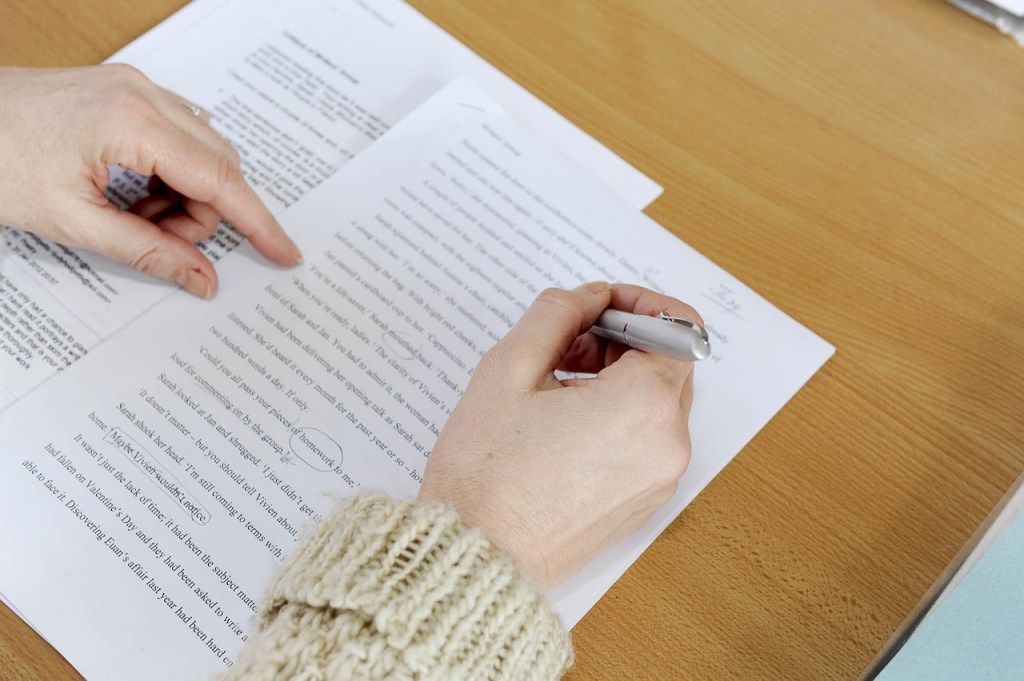
It is ALWAYS a good idea to have a break after you finish your first draft. I can offer suggestions as to how long the break should be, but only you can decide what works for your writing. A short story, for example, could be left for a couple of days, or a week, before you read it again with a critical eye. A novel: much longer. Zadie Smith is said to recommend two years. That may or may not suit your lifestyle or your writing ambitions!
The idea of a break is to give you distance from your work, so that when you return, you can read it like a reader, not the writer. That way you are more likely to identify errors. So, take a break and you’ll see your writing with clearer eyes in order to edit.
2. THE BIG PICTURE
This is what’s called Developmental Editing, where you take a look at your whole piece of writing, whether short story, article, novel or play, and just read it through. You should be seeing if the whole thing hangs together, makes sense and is entertaining. Here are some questions you need to ask, mostly for fiction but many apply to other forms of writing too.
Does the beginning grab you?
Do you want to read on?
Is it obvious who your main character – the protagonist – is?
Does the reader know what your protagonist wants, what their goal is?
Can your reader empathise with your protagonist?
Does your story start actively? No long set-up, back story or descriptions.
Do you have too many characters? Are they all necessary?
Do your scenes and chapters flow easily? Are one or more out of order?
Are your verb tenses consistent? You may be writing in the present tense and then include a flashback – make sure your readers know where they are!
Do you have chunks of description? Are these descriptions seen through the eyes of your protagonist, or have you slipped into narrator mode?
Are your characters doing something in every scene?
Is there enough/too much conflict?
Have you gone off on a tangent that has nothing to do with the main or sub-plots?
Are you guilty of repetition? This can happen if you have more than one point-of-view character.
Is your protagonist in charge of the action, particularly the action that resolves everything. Your protagonist must not be a passive character.
Has your protagonist changed and grown by the end of the story?
Is your ending satisfactory? It doesn’t have to be the clichéd “happy ending”.
Are all the conflicts and sub-plots resolved?
Hanging endings, where the writer leaves the reader to decide what happens, are perfectly acceptable. But they still have to be logical and satisfactory.
Next month I’ll look at How to read your work when editing; the nitty-gritty of editing; and where to go for help.
If you have any comments, please do send me feedback (click the button on the bottom left), plus suggestions for future posts.
And please subscribe to receive regular posts – it’s free!
Happy writing!
Linda
July 2024 Blog

Welcome to my new look website for the second half of 2024. Not sure where the first half went! I think I was a little too ambitious before and life always gets in the way! My aim is to bring you a blog at least once a month, with additional articles when I can.
I would really like the new-look website to be more inter-active. So please do send in your comments about my blogs or suggest any topics that you’d like to read about.
For this month, I thought I’d have a go at explaining AI – Artificial Intelligence.
AI – Artificial Intelligence – is the system by which computers are doing things that have been and are being done by humans. AI has been compared to the Industrial Revolution when machines took over traditional roles such as weaving.
You are probably reading most days about the latest AI applications: smart systems in our homes, enhanced diagnoses in healthcare, face recognition, driverless cars – the list will undoubtedly continue growing. And already, such well-known products as Google, Siri and Alexa are all examples of AI.

AI works by having access to all the digital information that is out there in the world – an almost inconceivable amount of data. But it means that AI is dependent on what has gone before, whether it is true or not. (A bit like Wikipedia whose entries can be written by anyone and are not necessarily factchecked.)
Schools and Universities
There has been a lot of debate over the use of AI in schools and universities. One of the major concerns is that students are using AI to write their essays and dissertations. It follows that we, as creative writers, could well use AI to write our short stories, articles and novels!
In fact, at one of my writers’ get-togethers, one member did offer a short story which, after feedback, he confessed had been written by AI. It wasn’t bad and I even remember complimenting the “writer” on his use of a tri-colon! Even so, his self-written story was definitely better.
So, should writers use AI?
The Pros and Cons:
Pros
Cons
My verdict
AI can be used very effectively in checking a piece of writing for errors. But when it comes to creative writing, let’s make sure it is we human beings who are being creative, not the machines.
If you have any comments, please do send me feedback on the form below, plus suggestions for future posts.
And please subscribe to receive regular posts – it’s free!
Happy writing!
Linda


 Let's Get Writing