How much is too much?
Do you like reading paragraphs or even pages of description? Do you love every detail of every place, building, street, garden, house, furniture, person and their pets in a story?
Or do you sometimes find yourself skipping over some of those paragraphs, hoping to find the action or conversation that will take the story forward.
It is too easy to include a lot of information in fiction writing, believing it to be essential to the story. But when there is a description overload, then I feel the author hasn’t given enough thought as to what the story needs.
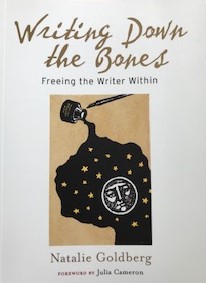
…there is a fine line between precision and self-indulgence
This is a quote from Natalie Goldberg’s book Writing Down the Bones – one of my favourite “How To” books on Creative Writing. It was written in 1986, sold more than a million copies and has been translated into 12 languages. (See link below)
I came across this particular quote when I was reading a few chapters (they are very short) the other day, hoping for inspiration. I got it! What immediately came to mind was those long passages of description that I have, unfortunately, been reading (or skipping) in quite a few books recently.
What is description? It could be setting the scene, describing someone’s clothes, or taking the reader through a five-course meal.
Please don’t get me wrong: I am very much in favour of using personal experience and/or research to bring authenticity to a story – you have to if you don’t want bland writing that doesn’t connect with your readers.
But how much is enough?
We’ve all probably done some research for a story, whether it’s the latest technology for a sci-fi tale, or what clothes they wore in the 15th century. Having done the research, we want to put it to good use. But that is the point at which you, the writer, must identify what the READER needs to know, rather than what YOU know.
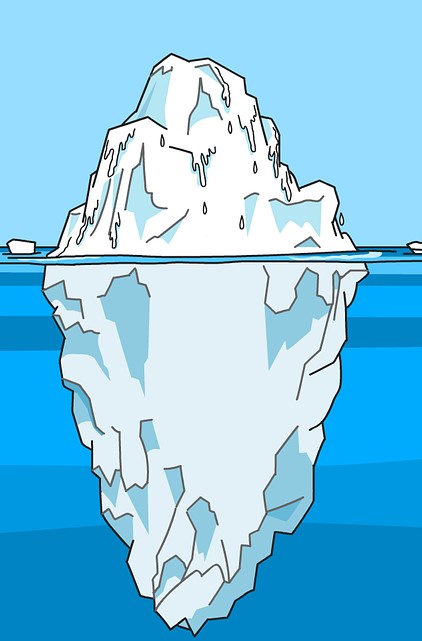
Ernest Hemingway had his “Iceberg” theory: “If a writer of prose knows enough of what he is writing about, he may omit things that he knows and the reader, if the writer is writing truly enough, will have a feeling of those things as strongly as though the writer had stated them. The dignity of movement of an iceberg is due to only one-eighth of it being above water.”
Over-writing is often described as PURPLE PROSE – writing that is showy, overly flowery; drawing attention to itself rather than progressing the story.
Sadly, new writers often tell me that “the words just poured out of me, so they have to be good, don’t they?”
I’m afraid not. That’s PURPLE PROSE at its worse – masquerading as words that flow when they and the plot have been well thought out and the author is thinking about every word.
How to avoid Purple Prose or
The dividing line between precision and self-indulgence:
- Try not to use too many adverbs and adjectives – stronger verbs and nouns are far more effective. Using too many weakens the verb or noun while the occasional adverb or adjective will make much more impact.
- Don’t search for fancy verbs – keep them simple but strong.
- By all means use similes and metaphors, but not too many and certainly not too close together. With metaphors and similes we are trying to give the reader an image but they will only get confused if there are too many different metaphors and similes close together.
- Don’t describe everything. Keep descriptions to the things that matter to your story.
- Try to mix descriptions with action and dialogue.
- Only use vocabulary that your Point of View character would use.
- Always think of what the reader needs to know (and how much they need to know) rather than what YOU know.
Don’t mistake Purple Prose for Literary Writing. We could spend hours discussing what, exactly is Literary Fiction! Authors of literary fiction are experts at using the right adjective at the right time, the right amount of description and the right words, even long ones, at the right time. Their writing flows and is beautiful to read. In addition to using metaphors and similes in the right place, they often employ other literary devices such as hyperbole and personification.
Genre writing on the other hand tends to be more direct, with more conversation and often more action. I believe it is just as hard to write good genre fiction as it is to write literary fiction. The choice is yours!
Happy writing!
Linda
Click here if you’d like to buy Natalie Goldberg’s book.
 Let's Get Writing